
89% signed up. Never shipped
How we rebuilt a shipping company’s merchant onboarding, turning a confusing first-time dashboard into a guided path to account activation.

Role
Product Designer Problem framing, Research , Solution
Collabrators
Commercial Team , 2 Product manger , Devs
Timeline
From Q3 2025 to Q1 2026
At a
glance
Problem
89% of new merchants signed up but never shipped. A passive checklist, early payment blockers, and a complex dashboard left them without a clear path to activation.
What we found
New merchants faced the full dashboard and payment blockers before experiencing Bosta's core value.
Outcome
Removing payment blockers raised activation ~5x || Guided onboarding lifted desktop activation from 7.78% → 11% (+3.22 pp) || Overall rate held steady despite 18% fewer signups

The number that Started everything
In August 2025, our onboarding funnel revealed that only 6 of 3,236 newly signed-up merchants completed account activation. Just 0.19% made it through the full journey, with the biggest drop happening before merchants created their first order.
This was the signal that pushed us to investigate what was stopping new merchants from getting started.


The biggest drop happened immediately after signup. Why were merchants leaving?
The pattern was bigger
To understand whether the onboarding drop-off was temporary or a broader trend, I reviewed a historical analysis prepared by Bosta's Data Analytics team.
Across 22,592 newly registered businesses, 89% never created a single order.The onboarding problem wasn't limited to one funnel or one week. It was happening consistently at scale.

This analysis gave us the confidence to dig deeper into why new merchants weren't getting started.
Merchants were asked to commit before They could experience value
The largest drop happened before merchants created their first order. Two mandatory steps stood between signup and the first meaningful action.

1
Signed up 🎉
Account created successfully

Excited ... Ready to start
Excited ... Ready to start
2
Top up EGP 1,000 Credits
Must to topup bosta credits to continue

Confused
Confused
Wait , i need to pay before i start ?
3
Insurance Popup Subscription
Selects a plan to continue

Another payment?
Do i really need this?
FRUSTRATED
FRUSTRATED

Removing the blockers worked... for a while
the Hypothesis 💡 we thought about it: If we remove the upfront credit top-up and insurance gate, more merchants will reach the first meaningful action: creating their first shipment.
BEFORE
0.129%
Oct 2 - Oct 5
AFTER
0.624%
Oct 9 - Oct 12

Amplitude From Weekly Funnel Web Chart
The first hypothesis was right... But it was’t enough
Removing the upfront Bosta Credits requirement and the insurance gate significantly improved activation.The experiment confirmed our hypothesis: Reducing friction helped more merchants reach their first shipment. But the improvement quickly plateaued.
The question changed
At First we asked
how do we remove the friction ?
now we are asking :
Why are merchants still leaving?
The numbers had taken us this far. It was time to hear the people behind them.
The data showed where merchants left
The conversations revealed why
I called three small merchants instead of sending another survey. I did not need to count the drop-off again. I already had that number. I needed to hear what a real person was thinking at the moment they gave up.
One merchant had just started a handmade-accessories brand. She signed up, landed on the dashboard, and froze.

I don't know what I should do.
A merchant who had just started a handmade-accessories brand
She assumed someone from the Commercial team would guide her through her first shipment. Instead, she was left alone in a dashboard full of actions with no clear path forward.
She Didn’t know:
Whether to create an order first
Whether she needed packaging
Whether bosta picked orders from her location
What the correct sequence actually was
Then I found the exact same story...
Merchants were already describing the same confusion inside Bosta's open Suggestion Box.

Suggestion box

It's been more than 24 hours since I made my account. I want to ship my products and no one has contacted me so we can start

I signed up a while ago, no one reached out, and I don't even know how to start.

I registered 48 hrs ago and no one contacted me yet…
The product assumed knowledge
New merchants didn't have
New merchants weren't struggling to navigate the interface. They were trying to understand how shipping worked, what to do first, and whether they were doing it correctly.
What we learned from all previous thing
Merchants didn't understand the shipping journey.
The experience lacked a clear sequence.
Merchants needed a way to self activate their account without needing to wait fro the human touch support that could wait till 48hr .
Designing an onboarding that teaches , not assumes.
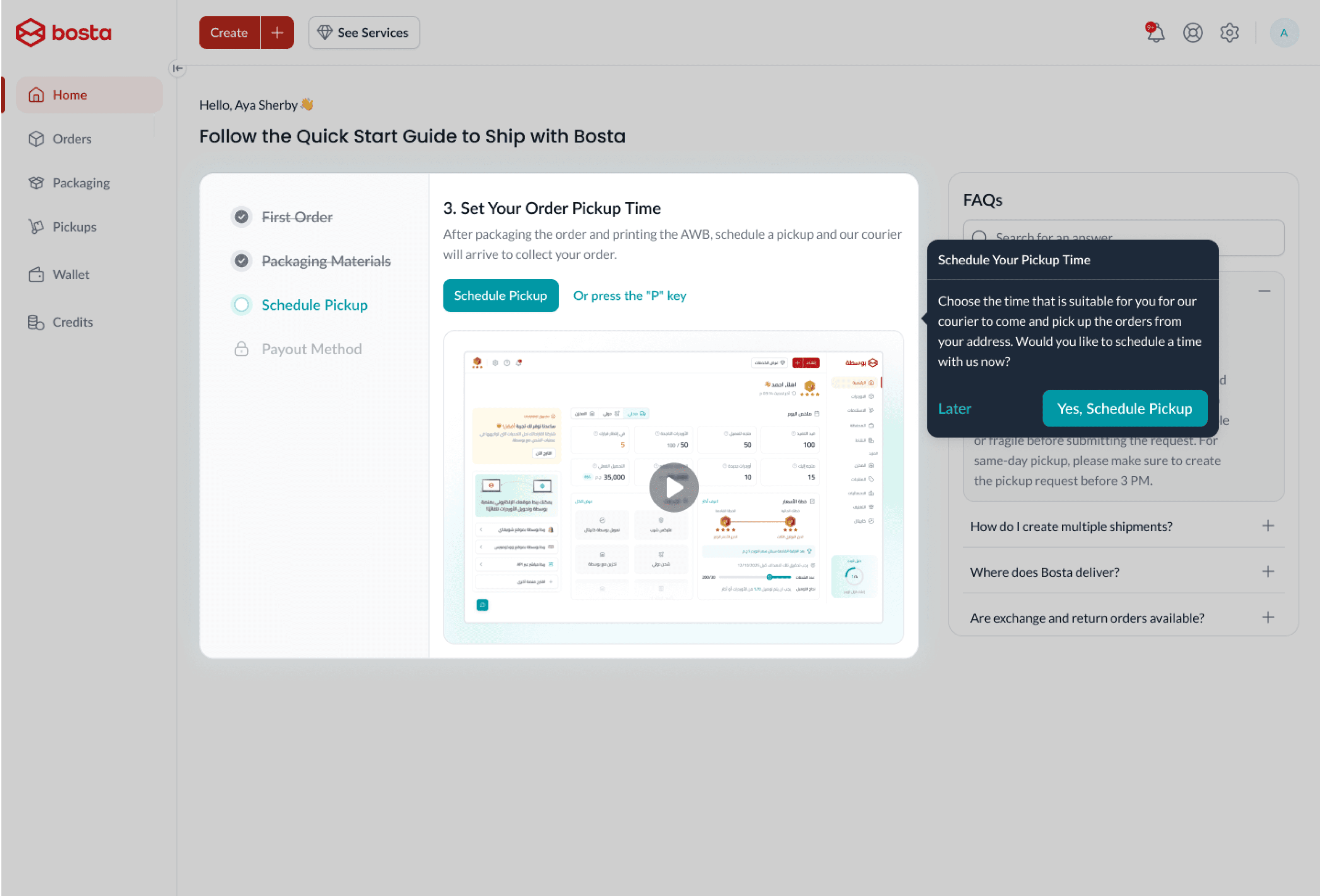
Instead of exposing new merchants to the entire dashboard at once, the onboarding guides them through the exact sequence they need to ship their first order. It teaches the repeatable shipping journey, from creating an order to requesting packaging and scheduling a pickup, while keeping account activation as a one-time final step.
The Journey they needed to know about it
+
Create your first order
Create your first order in minutes

Request Packaging
Get the packaging you need if you don’t have

Schedule pickup
Book a pickup at a time that works for you

Activate Account
Setup your payout and all account info
From a passive checklist to guided onboarding
The old homepage showed merchants what to do, but left them to complete the journey on their own. The redesigned experience connects each step to the real product, keeps progress visible, and makes the next action clear.

Passive Checklist
The homepage listed the onboarding steps, but guidance stopped there. Merchants had to leave the checklist, navigate the dashboard themselves, and figure out how each task worked.


Guided Onaborading
Switch to “Guided Tour” mode
The homepage transforms onboarding into a guided experience by focusing merchants on the next action, tracking their progress, and progressively revealing the rest of the dashboard as they gain confidence.

The impact: more merchants completed their first shipment
Eleven days after launch, we measured the impact of the redesigned web onboarding. Because our goal was to get merchants shipping with Bosta, we measured first-shipment completion: merchants who created an order, requested packaging, and scheduled a pickup. On desktop, it rose from 7.78% to 11%, and the overall rate stayed stable despite fewer signups.

Overall (All Platforms )
6.21% → 6.24%
1175 → 962 Signups (-18%)
Despite an 18% decrease in new signups during the experiment
Windows (Desktop)
7.78% → 11%
+3.22 pts
180 → 182 Signups (no change)
Strong improvement with the same number of new signups
Android (mobile)
4.44% → 4.45%
Flat
585 → 472 Signups (-19.3%)
No meaningful change even with fewer signups largest audience
IOS (mobile)
6.95% → 5.99%
-0.96 pts
374 → 184 Signups (-51%)
Conversion dropped on web , but many merchants shifted to the native app
What We learned?
Desktop merchants benefited most : The guided experience made the next action clearer and Increased Desktop First-Shipment Completion from 7.78% to 11%, a 3.22 percentage-point increase.
Mobile needs more attention : The first version was designed primarily for desktop, and the mobile results showed that smaller screens needed a lighter, simpler onboarding experience.
The data sent me back to the drawing board, on purpose
After launch, the data showed that many new merchants arrived on smaller screens, where the desktop experience felt too heavy. So I designed a lighter mobile version: the same guided path, with less information at once

The desktop launch showed me where the next opportunity was. Instead of leaving mobile limitations in a “what I’d do differently” list, I used the data to design the next iteration.
What I took from it
Onboarding shouldn't explain the whole product upfront. It should guide merchants to their next meaningful action, which for new merchants means their first shipment.
Research gave the numbers meaning
The funnel showed where merchants were dropping off. Merchant conversations explained why.
What I would do differently
Start mobile research earlier, since Android showed smaller screens needed a different approach from day one.
What I would measure earlier
Track every onboarding step from launch, to catch step-level drop-off immediately.
Where the work goes next
Extend this lighter guidance pattern to the wider merchant journey.

Next: 1.14M visits, and less than 1% actually bought
How I redesigned product-detail pages for seven Gulf e-commerce brands and built a reusable PDP framework — from a single urgent pilot to production across five stores.
See what happened
Case studies are best viewed on desktop
The case studies include detailed UI screens, design process, and visual explorations that are best experienced on a larger screen.
